When we put out our call a month ago for a Biblioasis Salary-Serf, we were not quite sure what we’d find. Truth be told, our job-description was meant to frighten away the wrong sort of candidates as much as it was meant to attract the right. We didn’t want someone who would be happy working for Bertelsman, or someone who saw this job as a mere foot in the door, a necessary period of resume and cache building before moving onto some more glamorous multinational existence in Toronto. We didn’t want anyone who thought that this job would be glamorous at all. As several people had commented privately and publicly, our Salary-Serf Call-to-Action was not really even a job description. It was far too wide-ranging and all encompassing and, to any sensible person, terrifying. But I also think that anyone who has spent any time in the small press trenches could have easily identified with what was written there. Indeed, in some ways, it only scratched the surface of what we do here, and what the new hire can expect to be involved in.
What I did not want – despite mentioning the hoped for publishing program experience – was a publishing professional. This is neither the place nor the position for someone who would think of him or herself in such a fashion. Into my seventh year as a publisher, I’m still nowhere near professional status, and don’t expect I’ll ever be so. I’m not sure it’s something I even aspire towards. This is still very much on-the-job training; I am still, on my best days, having too much fun; I am learning too much; I love it too much. And that, more than anything else, mattered to me. Finding someone who might just share the same enthusiasm for the work that I, most days, still have. It’s the only justification one can have for the long hours, the meagre pay. (Oh! That there was even meagre pay!) You must find it meaningful. “Blessed,” Thomas Carlyle writes, “is he who has found his work,” and I consider myself quite lucky to have found my own. More than anything else, I wanted the person I eventually hired to bring the same enthusiasm to the job. I wanted to know that, whomever we hired, they would care for our books and our writers as much as I do. As it was our new hire that reminded me of the true and fitting meaning of the word amateur, I believe that we have found the right person.
We had a dozen or so applications and letters of intent; we quickly narrowed these down to half-a-dozen, then three, and finally two. We wavered near a week between these, switching back and forth. We finally settled on Tara Kathleen Murphy, and not even a week into her involvement with the press we know we’ve hired someone quite special, who has already, in a few days, contributed to the press in several meaningful ways.
Tara comes to us from Western, where she is working on her doctorate in English. Before that she worked at McGill under Robert Lecker, where she finished a Master’s Thesis on the Porcupine’s Quill and Gaspereau Press, perhaps the two presses I most admire (& collect) in the country. She worked at the Word bookstore in Montreal under Adrian King-Edwards, one of the finest booksellers in the country. Tara has given a lot of thought to the role of the independent press in Canada, to the relationship between the physical book and its contents; she has a solid understanding of the industry and the independent press scene in particular. She’s a very fine editor, copy-editor, poet and artist; she has a good head for publicity; she’s an exceptional reader; and she seems to have solid administrative sense. She’s a bibliophile and book collector (I’ve never really been able to trust book people who are not). And she wants to get that old platen press in the garage up and working again. Bless her.
Just as importantly, she knew our books, bought our books, loved our books. She was familiar with our authors; particularly our poets. And she spoke of a small press life as one, at least in part, of service and community, and of the importance of finding meaningful work. It was as if she had read my mind.
But perhaps it is best to let Tara herself speak. Thirsty readers will be seeing a lot of her around here over the coming weeks and months and years, as will anyone else who deals with the press: at shows, readings, events, conferences. Many of our authors can expect to hear from her directly quite soon as well.
From her cover letter, applying for the Salary-Serf position. When I had read this, I had a sense I may have found my assistant:
"Part of this fastidiousness stems from my love of books as objects. I've been building my library for years, and right now I'm nourishing collections of typography manuals, small-press ephemera, and books about books. I couldn't say which item is my favourite (though my first-edition Memoirs of Montparnasse, unearthed in a church basement sale and bought for a dollar, is high on the list). What I can say is I've always believed that we have a moral obligation to produce quality work that lasts. Whether it's the extra fifteen minutes spent on a press release, or the extra cash spent for a sheet of Zephyr Antique Laid paper, the care we take speaks for itself. It's the best way we have of showing others that the stories we tell matter.
"I have always been personally invested in how books are made, and for this reason I have an enormous respect for the small press world. There's also no question that my interest in printers and publishers has done a lot to shape my own work ethic, which has served me well. It would be a privilege to apply my skills in an industry that I love, and to work for a press that I so deeply admire."
And it is a privilege to have her working with us.

Tuesday, March 08, 2011


Wednesday, March 02, 2011
Sunrise Launch Reminder
For those of you in Edmonton this Saturday, Goran Simic will be launching his new collection Sunrise in the Eyes of the Snowman at Audrey's at 2 pm. Help spread the word to all who can attend. Here, below, is a recording of Alan Rickman reading Goran's Sarajevo Spring.
Saturday, February 26, 2011
Sunrise in the Eyes of the Snowman
 A first review of Goran Simic's new collection Sunrise in the eyes of the Snowman was published in this morning's Telegraph Journal. The book launches in Edmonton at Audrey's Books a week from today, March 6th, at 2 pm.
From the review:
Simic writes from in-between languages, lands, self and others and stages of a life. It's a position perhaps made clearest in the opening lines of An Ordinary Man - "I am an ordinary man with ears of ordinary silk / and I speak only with a voice I've heard somewhere, / a voice like an echo."
Some poems employ rhyming quatrains. But Simic, wisely, uses this structure sparingly so that the form doesn't overwhelm the ideas. For example, the back-to-back pairing of No Time to Waste and When I Reached the Border, which both use the ABAB variation, work particularly well for two poems about a race for, and a crossing of, finishing lines. In the former, he's a "false stallion" tiring of life's everyday horse race. In the latter, he's "a mere bricklayer," shattered and heartbroken. He arrives at that boundary "already dead." The last line reads: "I have already died once. And now I'll never grow old."
The whole review can be read here. The book can be purchased from any quality independent (our preference), online or through our website here.
Truth and Lies in Poetry
 Robyn Sarah has taken over the helm as guest-blogger at the Best Canadian Poetry blog this week, and her first post is up, on Truth and Lies in Poetry.
Some years ago, at a poetry event, I heard a fellow poet preface his reading with the remark, “A good poem is like a good lie.” He meant, I assume, that both are verbal constructions that succeed based on the extent to which they can persuade us to believe them. Maybe he was half tongue-in-cheek, intending to be provocative, but nobody around me seemed provoked. I understood what he meant, but my own thought at the time was, “I could not disagree with you more.”
A successful lie manipulates language to achieve the effect of truth, but to me, a good poem is true. The power of the words comes from authentic emotion which is the moving spirit behind the poem. The words move us because the poet has been moved to words. Or, as I put it in the concluding sentences of my essay, “Poetry’s Bottom Line”: “Whatever else it is or does, a poem should deliver to us unmistakably the sense of an urgency behind the words. The sense that there was a need to say this. That the poet means it. That every word is a meant word.”
All too often, reading contemporary poetry, what I feel is, So many dishonest lines! Lines that sound beautiful but that aren’t meant. If you aren’t really paying attention, you can be seduced by them. But if you’re listening closely, they don’t ring true. They have the sound of trying too hard, or of trying to put something over. They sound as though they are listening to themselves, admiringly, rather than speaking from a real place inside the poet. The words may be gorgeous, they may be clever, they may have dazzle or flash, but they aren’t speaking in a real voice.
For the rest of this post, please go here. And if you like what you read there, then you may also want to check out Robyn's excellent essay collection Little Eurekas: A Decade's Thoughts on Poetry, where you will find a lot more of the same.
Thursday, February 24, 2011
Bookstores Need More Money, Less Mouth

From MobyLives.
The bookstore I co-founded and built from the acquisition of a single rare book is closing at the end of March. Wolfgang Books has been a mainstay of the Philadelphia area for the last five years. It has won four consecutive “Philadelphia Hot List – Best of Philly” awards and has never been shy of good press. Any walk of bibliophile can find something at Wolgang’s. Rare, used and plenty of new titles are to be had. Of the new titles I’d say 80% are from indie publishers and 100% are chosen by the bookseller.
That’s a lot of talk. Since my former business partner, Jason Hafer, to whom I sold my half of the company, announced that he was going to close the store because of slowed sales (and they are slow) I have heard a lot more talk. No doubt he’s heard still yet more.
“Was there no way to save it?”
“Are e-books killing bookstores?”
“I thought with Borders retreating it might get better for indies.”
“I always mean to go in but forget to.”
“These are hard times.”
“Amazon, Amazon, Amazon…”
Someone recently told me that they love the store and wished they had bought more books there — but Amazon, they said, was just too cheap. Not in the mood to accept their expiation I decided to tell them that the situation they just described was a major reason for the store’s closing. They acknowledged my point and proceeded to ask me if I knew whether the rare & collectible books were going to be on sale. Apparently paying full-price on front list paperbacks was too much of a hardship for him. Getting 40% off on a first edition of Celine, well, that right there fit snugly into the budget. Hell and damnation.
For the rest of this, please go here.
Tuesday, February 22, 2011
Reader's Discretion Advised

from the Stratford Gazette:
Combat Camera's subject matter will tempt some to steer around it. For readers of literary fiction who don't mind some grit, that would be a mistake. Somerset's language is pitch-perfect to the subject matter: the narrator has flashes of extreme wit and brilliance edged with self-deprecating sarcasm.
Zane and Melissa are sublimely aware of how ridiculous they are. ... For all the mockery, though, the characters and narrator are all stumbling toward something real ....
The book wraps up in just over 250 pages, leaving the reader feeling as raw as the characters left behind. Nor surprisingly, readers' discretion is advised. By turns wickedly funny, frustrating, and stunning, Combat Camera is a lean, mean read that will surprise you and leave you wanting more.
Monday, February 21, 2011
The Books of Spring: Open Air Bindery
Two and a half hours of shoveling snow gets a man thinking about Spring, which means, for us a new crop of fabulous books. The first of these, set to hit the presses this week, is David Hickey's second collection of poetry, Open Air Bindery.
This is David's second collection with us, following 2006's Gerald Lampert nominated In the Lights of a Midnight Plow. Bindery builds upon the myriad strengths of Plow to offer a tightly fantastic collection of songs, stories and covenants ranging across everything from art and astronomy to snowflakes and suburbia, each poem a small instance of colliding light, playful and humorous and profound. These poems, like the flakes in David's poem-sequence Snowflake Photography. take their "time / Covering the roadside trees in forms of (their) careful willing ... gesturing down to earth, unveiling new shapes / for all that (they) find/ here in the oldest of botanies."
David will be touring in March and April in support of Bindery, including the following:
March 21st: McNally Robinson, Winnipeg, MB for World Poetry Day
April 4th: TBD, Windsor, Ont. (With Joshua Trotter and Zach Wells)
April 5th: London Central Public Library, London, Ont. (With Joshua Trotter and Zach Wells)
April 6th: Dora Keogh, Toronto, Ont. (With Joshua Trotter and Zach Wells)
April 16th: Cobourg Poetry Festival, Cobourg, Ont.
April 27th: TBA, Kingston, Ont. (with Sarah Tsiang)
From Bindery, here's the poem (which may shed a bit of light on the title and cover image) X-ray. (This poem, incidentally, will be the next CNQ collectible broadside, due to hit mailboxes in early March.)
This is David's second collection with us, following 2006's Gerald Lampert nominated In the Lights of a Midnight Plow. Bindery builds upon the myriad strengths of Plow to offer a tightly fantastic collection of songs, stories and covenants ranging across everything from art and astronomy to snowflakes and suburbia, each poem a small instance of colliding light, playful and humorous and profound. These poems, like the flakes in David's poem-sequence Snowflake Photography. take their "time / Covering the roadside trees in forms of (their) careful willing ... gesturing down to earth, unveiling new shapes / for all that (they) find/ here in the oldest of botanies."
David will be touring in March and April in support of Bindery, including the following:
March 21st: McNally Robinson, Winnipeg, MB for World Poetry Day
April 4th: TBD, Windsor, Ont. (With Joshua Trotter and Zach Wells)
April 5th: London Central Public Library, London, Ont. (With Joshua Trotter and Zach Wells)
April 6th: Dora Keogh, Toronto, Ont. (With Joshua Trotter and Zach Wells)
April 16th: Cobourg Poetry Festival, Cobourg, Ont.
April 27th: TBA, Kingston, Ont. (with Sarah Tsiang)
From Bindery, here's the poem (which may shed a bit of light on the title and cover image) X-ray. (This poem, incidentally, will be the next CNQ collectible broadside, due to hit mailboxes in early March.)
X-Ray
So this is where I’ve hidden
my ghost, shadow of all
my firsts, essential self
shuttered down to its most
basic pajamas:
I’ve been looking for you,
ornithological bouquet
blooming in the dark
room of my days,
I’ve been walking around
in negative,
I’ve been wondering
how I fit, moony
white, in the wetsuit of my body —
so it’s good
to greet you at last,
and to see
there’s nothing wrong
with me, nothing
broken, nothing missing
but the wings
of a book
in my hand, nothing
but a little
lamplight
left on inside me.
Saturday, February 19, 2011
Friday, February 18, 2011
Upcoming Events
February 21, 2011
February 23, 2011
March 6, 2011
March 9, 2011
March 15, 2011
Tuesday, February 15, 2011

Monday, February 14, 2011
Charles Foran Wins Charles Taylor Prize

Congratulations are in order for Biblioasis alumni Charles Foran (Join the Revolution, Comrade) for winning the Charles Taylor Prize for Mordecai, his biography of Mordecai Richler. It's well-deserved.
For a video of Charlie Foran talking about Mordecai and why he chose to write the biography, please go here.
Customs (& Habit)
My favourite passage in Terry Griggs's excellent Thought You Were Dead has her hero at a countryside diner, The Coffee Nook, amongst a crew which includes Nietzsche-quoting farmers and Annie Dillard reading waitresses. This Friday, heading over to the US to do an American mailing of ARCs and review copies and a few sold books besides, I had a real-life taste of this Griggsian world. Normally crossing the border is the most stressful part of the whole ordeal, far worse than waiting in line for an hour or so at the Fort Street post office, worse than spending an hour plus affixing stamps to the 198 review copies we had with us on this occasion. The general rule is the more interest a border agent takes in what you're bringing across, the more likely you're in for it. Books may be duty free, and what we're doing may be completely legal, but when you're ordered to put your car into park, and the agent takes your ID, and you know you're in a no man's land that's not beholden to the laws of either the country you left or the one you're trying to make a brief foray into, any deviation from the usual quick glance at your ID and paperwork before taking your 10.75 causes more than a little anxiousness. And this agent was taking his own sweet time.
"What's this Combat Camera you're bringing over," he asked, I told him, treading lightly over the pornography storyline, just in case he got the wrong idea. "And Light Lifting? The Meagre Tarmac?" I told him. "All review copies going to newspapers and magazines across the country. The lists of recipients are attached." And they were
He flipped to the last few pages, of books I was bringing across for paying customers. A few Biblioasis titles, used book orders from the internet, odds and sods. Among them was Ryszard Kapuscinski's I Wrote Stone.
"And what about this one?" he asked, referencing the Kapuscinski. I was worried: it's an obviously foreign-sounding name, a possible red flag. This had happened before, when someone came across Goran Simic's name. And this guy was asking far too many questions. I told him it was a book of Kapuscinski's poetry we published a few years ago.
"Well now," he drawled, "Ryszard Kapuscinski isn't exactly well known for his poetry, now, is he?"
I had to agree that, indeed, he was not. And so we chatted for a few moments about Ryszard Kapuscinski and our books and press before he asked for 10.75, handed me back my passport and sent us on our way.
It did not end there. There was the usual long line at the post office, and I got into a discussion with the gent ahead of me about what we were doing with so many packages. On learning I was a publisher he asked about our books and seemed genuinely interested in what he heard. Then he said, "Well now, I've been working on a book for quite some time and I was just beginning to think of sending it around. Might you care to take a look?" Publishers get these requests all of the time: it's one of the reasons I always hesitate to let anyone know what it is I do. Everyone, after all, seems to believe they have a book in them (You know the old joke: There's a surgeon and a writer at a party. And the surgeon says to the writer...) I steeled myself for the usual, but this fellow ended up having an interesting story to tell, about his parents and the Detroit Riots of '68 and all that followed after, and by the end of it he had a card, and down the road perhaps I'll even have a manuscript to look at. Not my usual Detroit post office adventure, but one that leaves me a bit more hopeful when sending our books out there.
"What's this Combat Camera you're bringing over," he asked, I told him, treading lightly over the pornography storyline, just in case he got the wrong idea. "And Light Lifting? The Meagre Tarmac?" I told him. "All review copies going to newspapers and magazines across the country. The lists of recipients are attached." And they were
He flipped to the last few pages, of books I was bringing across for paying customers. A few Biblioasis titles, used book orders from the internet, odds and sods. Among them was Ryszard Kapuscinski's I Wrote Stone.
"And what about this one?" he asked, referencing the Kapuscinski. I was worried: it's an obviously foreign-sounding name, a possible red flag. This had happened before, when someone came across Goran Simic's name. And this guy was asking far too many questions. I told him it was a book of Kapuscinski's poetry we published a few years ago.
"Well now," he drawled, "Ryszard Kapuscinski isn't exactly well known for his poetry, now, is he?"
I had to agree that, indeed, he was not. And so we chatted for a few moments about Ryszard Kapuscinski and our books and press before he asked for 10.75, handed me back my passport and sent us on our way.
It did not end there. There was the usual long line at the post office, and I got into a discussion with the gent ahead of me about what we were doing with so many packages. On learning I was a publisher he asked about our books and seemed genuinely interested in what he heard. Then he said, "Well now, I've been working on a book for quite some time and I was just beginning to think of sending it around. Might you care to take a look?" Publishers get these requests all of the time: it's one of the reasons I always hesitate to let anyone know what it is I do. Everyone, after all, seems to believe they have a book in them (You know the old joke: There's a surgeon and a writer at a party. And the surgeon says to the writer...) I steeled myself for the usual, but this fellow ended up having an interesting story to tell, about his parents and the Detroit Riots of '68 and all that followed after, and by the end of it he had a card, and down the road perhaps I'll even have a manuscript to look at. Not my usual Detroit post office adventure, but one that leaves me a bit more hopeful when sending our books out there.
Thursday, February 10, 2011
Light Lifting: the Commonwealth Edition

We received work this afternoon that Alexander MacLeod's Light Lifting, which was shortlisted for some other prize back in the Fall, has been shortlisted for the Commonwealth Prize's best first book, Canadian and Caribbean Edition. Winner announced March 3rd, and will face off against other regional winners.
Other shortlisted books include:
Bird Eat Bird by Katrina Best (Canada)
Doing Dangerously Well by Carole Enahoro (Canada)
Mennonites Don’t Dance by Darcie Friesen Hossack (Canada)
The Cake is for the Party by Sarah Selecky (Canada)
Ilustrado by Miguel Syjuco (Canada)
Congratulations to all.
Wednesday, February 09, 2011
Biblioasis Hand-bound
 When I first started Biblioasis six years, four months and five days ago (yes: at this point and time I am aware of the passing of every bloody second) I started it with the idea of it being a boutique-style press. The idea to start publishing actually came, at least in part, because I had taken a few bookbinding courses and was tired of making blank notebooks. When I started out, I intended that every trade book and every chapbook would have a hand-bound component. And, for a while, at least, I kept it up. Our first four trade books and nine chapbooks had hand-bound editions. And I have text blocks ready for binding for quite a few of the next dozen or so titles that followed. I even have a small binding room built in the garage, which proves that as little as three years ago I thought there was a chance I'd catch up. But I never did. Something I've become used to, as a publisher: my ambition being beat down by the tripartite realities of (1) not enough hours in a day; (2) not enough gas in the tank; and (3) not enough cash in the till. I was a Fool (Destined to be the working title of a future autobiography.) to believe it would be otherwise.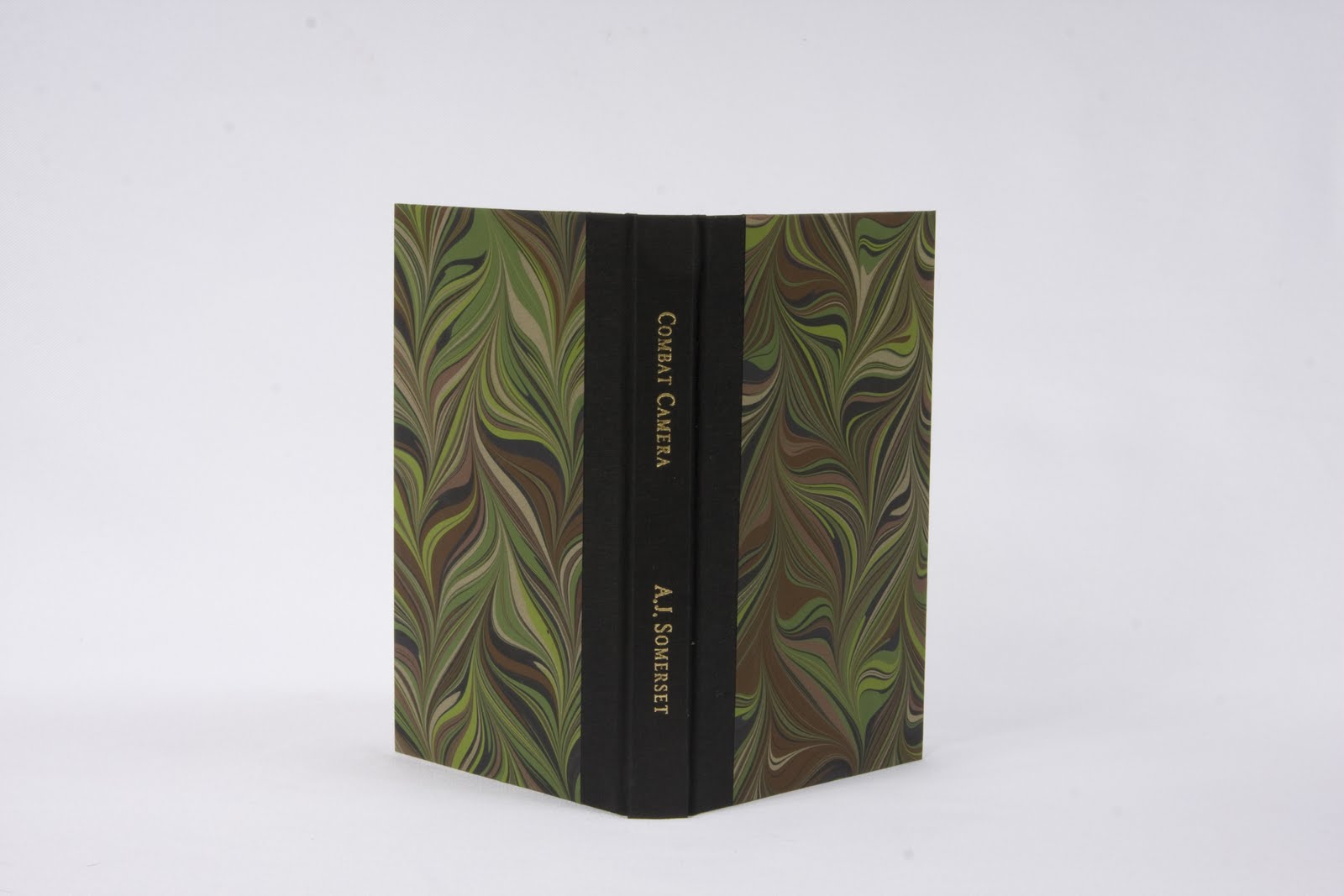
But I've always regretted abandoning this part of our publishing program, and I've always intended to get back to it. As a bookseller, book collector, bibliophile (or, when manic, mane), luddite, it's important to me. And in a digital age, when the
I'd hoped to have these ready well before the new year, to take advantage of the Christmas conasumerist frenzy, but it wasn't to be. We've produced two hand-bound editions of Fall 10 titles, a run of 50 copies of the first printing of Alexander MacLeod's Light Lifting, numbered and bound into hand-marbled papers; and a further run of 30 copies of A.J. Somerset's excellent Combat Camera. Both produced for the press by the wonderful Kate Murdoch (I seem to have even less hours in a day, and far less gas in the tank; but thanks to a better than average Fall 11, a few more dollars in the till.) Priced at 60.00 each, they can be purchased through the website -- just click on the hand-bound/hardcover link on the right side of the given book's page (For MacLeod, here; here for Somerset) -- or email me direct. If I can blow off the dust and put on my bookseller hat for a second, these are cheap at the price, and won't (or at least shouldn't) last long. Both will go for far more in as little as a few year's time. Especially if the Twitterverse is indeed correct, and the physical book is dead.
We'll be producing one or two such limited hand-bounds a season going forward, for as long as we can afford to do so. Clark Blaise's The Meagre Tarmac will follow this Spring. If any out there are interested in placing a standing order for these titles, let me know and we will get you off all new hand-bound titles as soon they are ready.
Monday, January 31, 2011
Readings
Zach Wells has a poem in this issue of the Walrus, called, I think 'Underwhelmed, if that's a word," which can be read here.
Again, in the Walrus, Biblioasis-friend and regular CNQ contributor Jeet Heer has an interesting essay on the Canada Reads phenomenon.
Stephen Henighan -- currently warping young minds over in Paris, France -- is at it again the pages of Geist, this time with an thoughtful essay on the BookNet Dictatorship.
There's a fab new Amy Jones story up at Taddle Creek, titled Atikokan is for Lovers.
Cynthia Flood has a new story up at Found Press called Addresses.
Though it isn't online, the current issue of Fiddlehead has a moving story, Freight, by Shane Neilson.
Again, in the Walrus, Biblioasis-friend and regular CNQ contributor Jeet Heer has an interesting essay on the Canada Reads phenomenon.
Stephen Henighan -- currently warping young minds over in Paris, France -- is at it again the pages of Geist, this time with an thoughtful essay on the BookNet Dictatorship.
There's a fab new Amy Jones story up at Taddle Creek, titled Atikokan is for Lovers.
Cynthia Flood has a new story up at Found Press called Addresses.
Though it isn't online, the current issue of Fiddlehead has a moving story, Freight, by Shane Neilson.
Subscribe to:
Posts (Atom)