It
is with real pleasure and tremendous excitement that we can announce to Thirsty
readers that the fabulous Kathy Page has made the Giller longlist for her
equally fabulous short story collectionParadise
& Elsewhere.
Jurors Francine Prose, Justin Cartwright and Shauna
Singh Baldwin read through 161 books to select a longlist of 12 titles. "We’re celebrating writers brave enough to change
public discourse, generous with their empathy, offering deeply immersive
experiences," they announce in the official Giller Prize press release.
"Some delve into the sack of memory and retrieve the wisdom we need
for our times, others turn the unfamiliar beloved. All are literary
achievements we feel will touch and even transform you."
That bit about retrieving the wisdom we need
for our times, or turning the unfamiliar beloved, of achievements which both
touch and transform … I don’t know a better description for Paradise & Elsewhere. Congrats to Kathy: it’s richly deserved.
The
longlist for the 21st Scotiabank Giller Prize is:
The
Giller shortlist will be announced on Monday, October 6th, with the
winner announced Monday November 10th.The winner will receive $100,000, with each
shortlisted book receiving 10,000 each.For the full press release, please go here.
All of us here at Biblioasis are proud to announce that Clark Blaise was named among the five finalists for the Rogers Writers' Trust Prize For Fiction this morning for his wonderful collection The Meagre Tarmac. Finding ourselves in Toronto following Ray Robertson's glorious Why Not? Fifteen Reasons to Live launch, we headed to the Rogers' announcement at Ben McNally's and we nearly jumped for joy when the first words by the announcer turned out to be "exploring the places where tradition, innovation, culture and power meet with explosive force...." At that moment, no words could have sounded more beautiful.
Heartfelt thanks to the jurors for this: Rabindranath Maharaj, Emma Donoghue and Margaret Sweatman, and warm congratulations to the rest of the authors and their publishers:
Michael Christie. The Beggar's Garden (Harper Collins) Patrick deWitt. The Sister's Brothers. (Anansi) Esi Eduygan. Half-Blood Blues (Thomas Allen) Dan Vyleta. The Quiet Twin. (Harper Collins)
for more information on the Award and the shortlist, please go here.
To see my shaky iPhone video of the first 16 seconds of the announcement, please click below. (I had to put my phone to clap, which ended that.)
Over at his blog Michael Bryson has offered up a rave review of Clark Blaise's The Meagre Tarmac, nominated Tuesday for a Giller Award. Here's how it starts:
Masterpiece. That's a big word. In 20 years of writing book reviews I don't think I've ever used it, but I'm throwing the dart atClark Blaise's new short story collection,The Meagre Tarmac(Biblioasis, 2011).
The eleven short stories inThe Meagre Tarmaccontinue Blaise's interest in the social construction of identity. This time, however, his characters are not exploring the two solitudes of North America's English/French divide. The characters in this book are nearly all Indo-American. The two solitudes on display here are the East and West. Also, cultural tradition versus liberal capitalism.
Post-Obama, are wepost-racial? Blaise's book argues emphatically,no. But it's anothat is dense with complication.
In an earlier age, this book would be a lightening rod for an "appropriation of voice" debate. How can this white dude write from within the perspective of the Indo-American population? And he does it over and over, in precise detail, and so well!
Clearly, the author has experience of Indo-American culture through his in-laws, but (more importantly) he has brought to it a lifetime of experience, a lifetime of thinking through precise cultural differences, a lifetime of mastering the short story.
And it is a mastery, here, that ought to be celebrated. And read. And studied.
We, of course, couldn't agree more. For the whole review, well worth reading, please go here. (And sorry about the mustard colour highlighting: can't seem to steal from Bryson's blog without it. )
When I first started Biblioasis six years, four months and five days ago (yes: at this point and time I am aware of the passing of every bloody second) I started it with the idea of it being a boutique-style press. The idea to start publishing actually came, at least in part, because I had taken a few bookbinding courses and was tired of making blank notebooks. When I started out, I intended that every trade book and every chapbook would have a hand-bound component. And, for a while, at least, I kept it up. Our first four trade books and nine chapbooks had hand-bound editions. And I have text blocks ready for binding for quite a few of the next dozen or so titles that followed. I even have a small binding room built in the garage, which proves that as little as three years ago I thought there was a chance I'd catch up. But I never did. Something I've become used to, as a publisher: my ambition being beat down by the tripartite realities of (1) not enough hours in a day; (2) not enough gas in the tank; and (3) not enough cash in the till. I was a Fool (Destined to be the working title of a future autobiography.) to believe it would be otherwise.
But I've always regretted abandoning this part of our publishing program, and I've always intended to get back to it. As a bookseller, book collector, bibliophile (or, when manic, mane), luddite, it's important to me. And in a digital age, when the twitter-verse is alive with chatter (ceaseless, ceaseless chatter) about the end of the physical book, perhaps it's even more important to get back to it. So, in fact, I have.
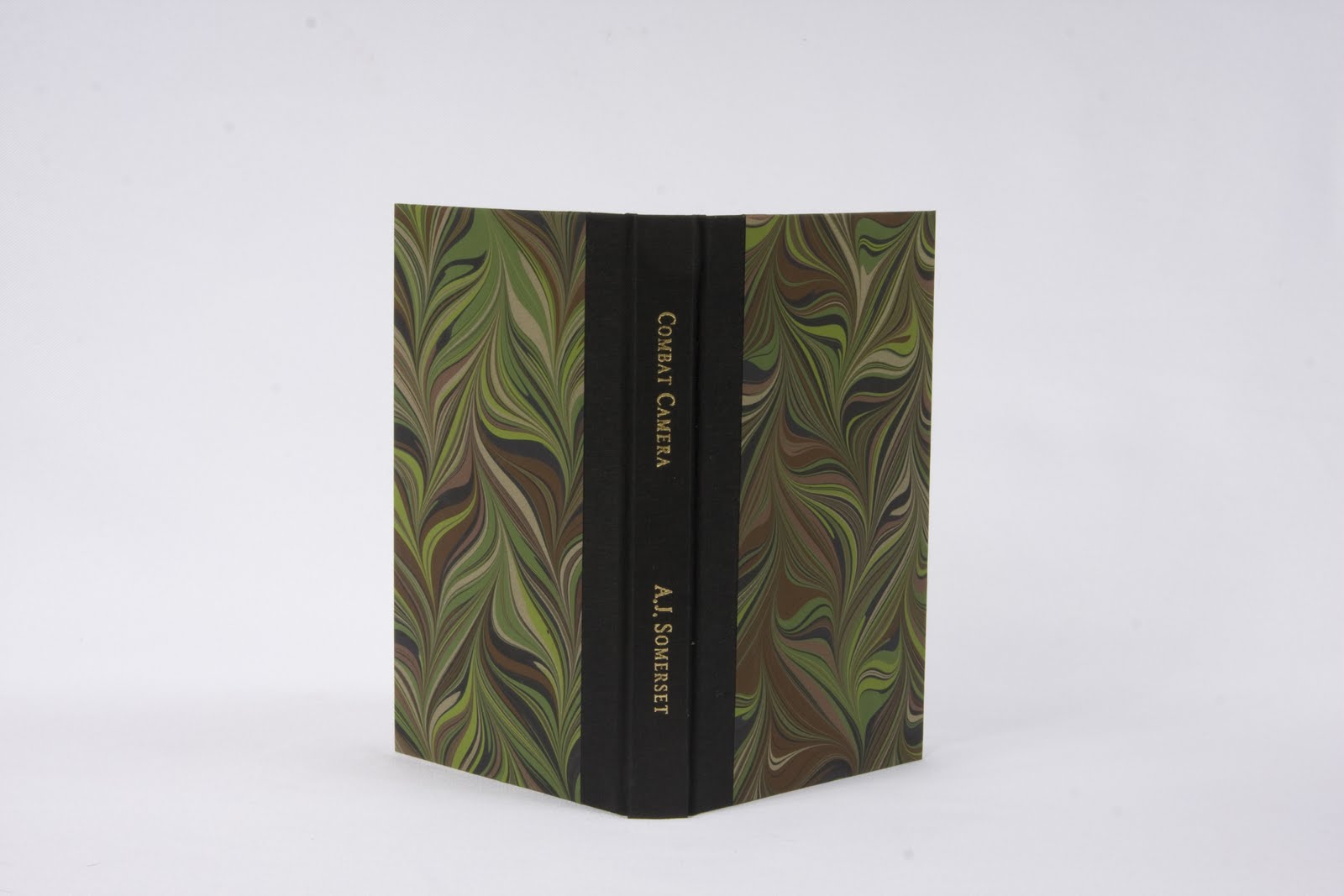
I'd hoped to have these ready well before the new year, to take advantage of the Christmas conasumerist frenzy, but it wasn't to be. We've produced two hand-bound editions of Fall 10 titles, a run of 50 copies of the first printing of Alexander MacLeod's Light Lifting, numbered and bound into hand-marbled papers; and a further run of 30 copies of A.J. Somerset's excellent Combat Camera. Both produced for the press by the wonderful Kate Murdoch (I seem to have even less hours in a day, and far less gas in the tank; but thanks to a better than average Fall 11, a few more dollars in the till.) Priced at 60.00 each, they can be purchased through the website -- just click on the hand-bound/hardcover link on the right side of the given book's page (For MacLeod, here; here for Somerset) -- or email me direct. If I can blow off the dust and put on my bookseller hat for a second, these are cheap at the price, and won't (or at least shouldn't) last long. Both will go for far more in as little as a few year's time. Especially if the Twitterverse is indeed correct, and the physical book is dead.
We'll be producing one or two such limited hand-bounds a season going forward, for as long as we can afford to do so. Clark Blaise's The Meagre Tarmac will follow this Spring. If any out there are interested in placing a standing order for these titles, let me know and we will get you off all new hand-bound titles as soon they are ready.
So: this part of it is almost over. Today I work on final details and packing and trying on my tuxedo, hoping -- despite the sedentary nature of the last two to three weeks as we try and keep up on everything (sadly, failing) -- that it still fits. Tomorrow we head to Guelph at the Bookshelf for an event with CNQ, TNQ, K.D. Miller, Seth, A.J. Somerset, Shane Neilson and Jessica Westhead (7 pm). Then off to Toronto for the Giller gala. Then a couple of frantic days in Toronto -- whether we win or lose -- before Minneapolis for US Sales Conference. And then, hopefully, things become far more manageable.
This whole Giller experience has been.... something else. Too radically different from my day-to-day existence and focus for the last six years as a publisher to comment on in any way at the moment. Except to say that we are extremely grateful to the Giller Jury of Ali Smith, Claire Messud, and Michael Enright for landing us on this most interesting of all shortlists, and for all of the opportunities which have resulted from it. Also to Elana Rabinovitch and June Dickinson, who have been gracious in guiding us through the maze by the elbow, the CTV crews who have handled their material so well, and to Jack Rabinovitch, whom I have yet to meet, but look forward to thanking on Tuesday in person.
Win or lose -- and the odds seem certainly stacked more one way than the other -- we have already won. The spotlight has shone on a few small presses in a way that it never has before, and may never again, and I feel that, despite a few hiccups, all has been handled rather well. A first book of short fiction which had seen initial orders of approximately 300 copies has now sold thousands, and should continue to sell regardless of what happens on Tuesday. Two of our writers have made the final five. (Anansi, of course, may beg to differ: but Kathleen Winter will always be one of ours.) Two excellent short story collections have made the cut, and perhaps a group of readers have discovered (with the exception of Andrew Gorham (but you can't please everybody)) that short stories might have something to offer after all. As the press in Canada which publishes more short story collections (at least as a percentage of output, if not in fact) than any other press in the country, this is a very good thing indeed.
The photograph above was taken back of the Gladstone Hotel in Toronto the day of the Toronto launch of Light Lifting, 24 hours after the book made the Giller longlist and 48 hours after it was published. I think we both look a little more tired these days, but are greatly appreciative for what these last 7 weeks have wrought.
Today the Toronto Star published it's review of Light Lifting, and as they were the first to profile Alex after the longlist, it seems fitting to end this run with their review. Here's a taste of what James Grainger has to say:
Critics, authors and scholars still routinely attempt to define the parameters of a distinctly Canadian literature by discussing issues of regionalism, multiculturalism and rural versus urban living. But it takes a book like Alexander MacLeod’s Giller-nominated debut story collection, Light Lifting, to remind you what’s missing from so much sanctioned CanLit: the daily grind of work and its impact on the lives of ordinary people.
Reading the output of so many of our celebrated authors, you’d think that nine out of 10 Canadians of the last two centuries were explorers, cartographers, sea captains, archivists, artists, intellectuals, journalists and convention-defying rural doctors, teachers and midwives. A reader from away might well ask: Who built the houses and vehicles for this nation of solitary types brooding over questions of personal and national identity? Who delivers their pizzas?
MacLeod’s characters do those things and even dirtier jobs. Few authors in this country have delved so deeply into the workplaces of working-class Canadians as MacLeod, and the characters he finds there are as rich and complex as any of the cerebral exotics that populate the work of Ondaatje, Urquhart and Atwood.
Yet none of the seven stories in Light Lifting can be reduced to mere kitchen-sink realism. Though all are technically of the naturalist school, MacLeod’s stories employ multiple narratives and stylistic techniques to capture the particular tone and texture of the dramatic situation unfolding.
Over at the Hamilton Spectator this morning there is another excellent review of Light Lifting. We're at IFOA, on a Giller whirlwind: CTV interviews, special tapings, IFOA readings. Hopefully I'll be able to post photos and video and a report later. But, for now, this from the Spec:
Miracle Mile features two track athletes, one or two notches down from the ultra international elite, but still good enough to travel the world, make the Canadian team, to expect the perks and be fawned over. What’s intriguing is the solitude MacLeod places the pair in, the final race they run, the context in which they compete. The title comes not from the Miracle Mile (run in 1954 at the Commonwealth Games in Vancouver), but from the ultimate game of chicken they’d play in a railway tunnel underneath the Detroit River. Not only do you get deep into the psyches of the lifelong friends, but you can smell their desperation, the scorching heat and power of the locomotive, feel the scurrying rats in the darkened Windsor-bound tunnel, feel the palpable tension between them on the track. And that’s one of MacLeod’s strengths — bringing into play all the senses while ratcheting up the tension. Windsor figures prominently in several other stories: Adult Beginner I (a young women who narrowly escapes drowning as a child in an undertow finds herself, ironically, in a different, yet similar predicament); The Loop (about a young boy’s drugstore delivery route, stopping at various rest homes and places where ex-Chrysler workers have holed up to live out their days after a life of tightening minivan bolts), and Light Lifting’s best story, The Number Three (which serves as both a paean to the above-mentioned minivan, and to the bereft, catatonic father and husband who has to face a cathartic moment, which unfortunately has come to define him). MacLeod’s prose is reminiscent of Annie Proulx’s: It carries much weight in its sparse, straightforward style. More please, and soon.
You can read the whole review here. And if you're in Toronto tonight, come down to IFOA and see the Giller finalists.
The next leg of the triumphant Biblioasis fall tour begins with a whimper emitted by a writer forced to rise before the sun to make his train. There is a certain amount of groggy stumbling about, and the packing of last minute supplies: two bottles of whisky, a large bottle of Tylenol, a number four Phillips screwdriver, a small flashlight, and a large Band-Aid. Not all of these things will prove necessary, but it is best to be prepared. You never know.
The countryside is sodden. Somewhere beyond Kingston, a driver decides to race a westbound train, and loses. All trains sit stopped until the investigation is complete, although there seems to be little left of the car to investigate. The train arrives in Montreal an hour late.
The hotel is perhaps insalubrious. The room features a non-functional Jacuzzi and, surprisingly, mirrors on the ceiling. All attempts to relax are futile; staring up at your reflection in the mirror induces immediate and uncontrolled giggle fits. You examine this throwback to a forgotten era of tastelessness while sipping The Famous Grouse from a plastic cup. Whether the mirror or the whisky is more alarming is an open question. It is just possible that this is rock bottom.`
You are not the kind of guy who would be at a place like this at this time of the evening, but here you are, and you can`t say the terrain is entirely unfamiliar. Drawn & Quarterly is packed, and discreet inquiries confirm that the crowd is here for the reading, not merely for the chance to get in out of the rain. People shake your hand and congratulate you. You thank them. Gnawing at the back of your mind is the question of what you`re going to read.
Harold Hoefle reads first, having lost the coin toss. Alexander MacLeod introduces you with the weight and gravitas proper to a Giller finalist: "This book is about war. It's about pornography. And it doesn't suck!"
You read. People question, You answer. There is a certain amount of signing things, chiefly books.
It is now necessary to brace yourself against the considerable strain of the reading experience. You stumble out into the street and into the nearest bar. You haven't eaten since lunch, and lunch itself is debatable, provided as it was by Via Rail. The word at the bar is to avoid the quiche. Also, the hot wings, french fries, onion rings and nachos. Rumour has it that the pizza is safe. It is difficult to identify the toppings in the poor light. You engage in a preventive disingection of the alimentary canal using alcohol, a highly effective disinfectant.
Someone begins dancing on a table. You could swear it. The rest is a blur. You recall laughing at your reflection on the ceiling just before losing consciousness.
The next leg of the triumphant Biblioasis fall tour begins with a whimper emitted by a writer forced to rise before the sun to make his train....
This was Alexander MacLeod's first public reading from Light Lifting. He'd held the book for the first time only thirteen hours before, in my hotel room in Guelph.
I've several other launch videos from this Fall -- including another from tonight's Nieve event in London -- I'll be posting in the coming days and weeks. So stay tuned.
The Globe & Mail Book Blog has just posted a chat Julie Wilson had with Alexander MacLeod in advance of his appearance at IFOA on Sunday. Here's a snippet:
9:52
BookMadam:
How much of yourself is in these stories? What elements are perhaps much closer than they appear if only to you and the people who know you?
Friday October 15, 2010 9:52 BookMadam
9:55
Alexander MacLeod:
All of this stuff comes from me and my life. I delivered prescriptions and did interlocking brick and I was a competitive runner and I have small kids, yes, but these aren’t autobiographical stories. My wife is not the wife in ‘Wonder About Parents’ – she’ll tell you that in an instant – and I’m not the kid who faces what has to be faced in ‘The Loop,’ but we’re close enough to those characters to recognize their situations. (I, too, loved the Dukes and was surprised to learn during the copy-editing that Hazzard country has two “Zs”)....
Friday October 15, 2010 9:55 Alexander MacLeod
9:58
Alexander MacLeod:
Everybody, of course, thinks this is straight up autobiography but I hope that’s a sign that the stories are doing their work in the right way. When I write a story, like anybody else, I can re-arrange everything in my own experience in order to make a better narrative. I can bring in new elements or new people and I can cut others out. I can do whatever I think needs to be done in order to deliver something worthwhile to a reader. There are moments, tense moments, in every real life where fairly fundamental challenges need to be faced. And, again, like everybody else, I’ve had some of those, but, as I always say to my students, a tense experience or a sad experience or a terrifying experience does not guarantee, or even necessarily lead towards a tense, sad or terrifying story. Writers make those kinds of stories, and they have to work hard to trigger those effects. In my case, I made the stories out of the materials at hand, but I think they sink or swim based on how they're made rather than what they are made of.